Ronin, the gaming blockchain built by Sky Mavis for Axie Infinity, announced on June 18, 2024 that it planned to let game developers launch their own zero-knowledge layer-2 networks on top of it. Builders would use the Chain Development Kit (CDK) from Polygon to create these "zkEVM" chains while staying connected to Ronin's players, wallets and marketplaces.
Historical news event: 2024-06-18. Retrospective report prepared November 2026.
It was a plan, not a product launch. The official announcement said the CDK would be available "soon" and that, if things went to schedule, the first zkEVM chains could arrive in the first quarter of 2025.
What Ronin proposed
Ronin had grown as a single shared network for games. Its proposal added a second layer: a studio could spin up its own execution environment, a zkEVM layer 2, that settled back to Ronin. Zero-knowledge proofs would let Ronin check the activity on those chains without redoing all of it.
The company said deployment would be permissionless, with one condition. Whoever launched a chain had to run a Ronin validator, which required 250,000 RON. Sequencer fees from each layer 2 would go to the validator running it, which Ronin said could raise staking rewards for the people delegating to that validator.
Ronin also said it was exploring Polygon's AggLayer, a system for connecting many chains, and that it might "eventually" use it to become a layer 2 itself. That line turned out to matter more than anyone expected at the time.
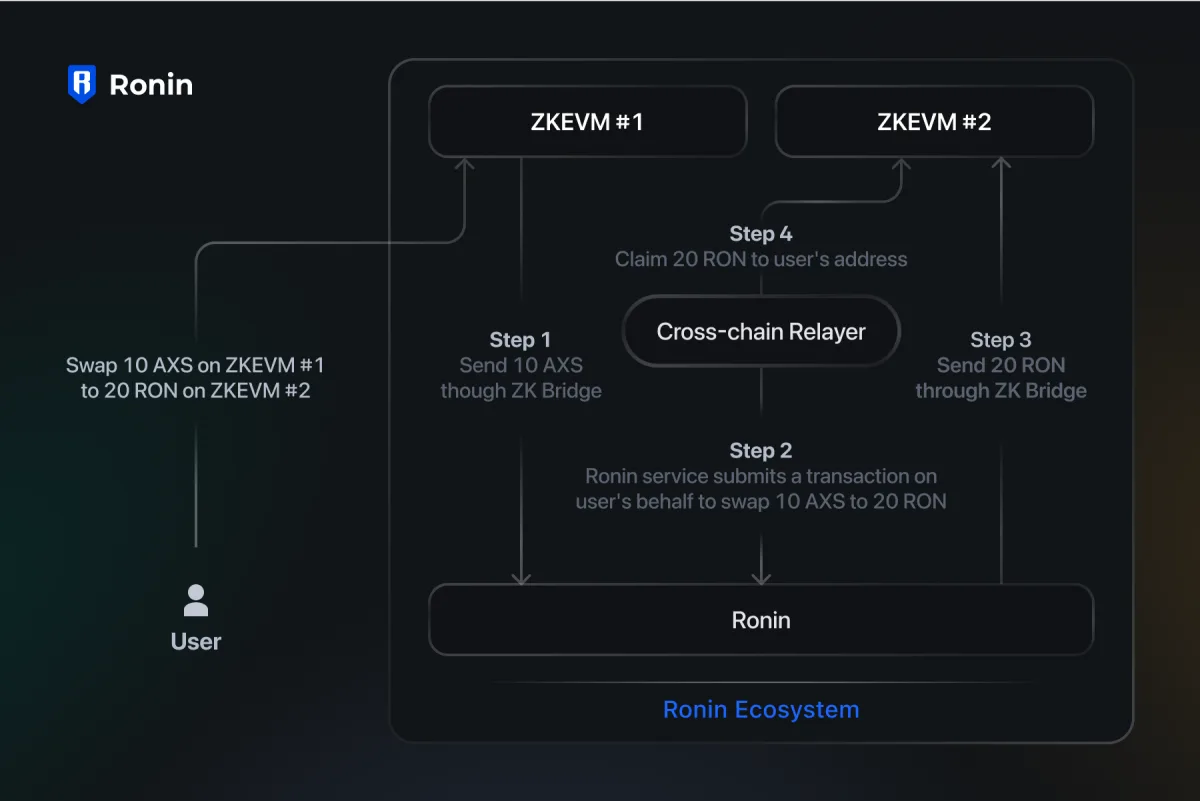
Image: Ronin
Why games wanted their own chains
Players don't care how blocks are built. They care that a sword they buy shows up, that a trade goes through and that the game doesn't slow to a crawl when everyone logs in at once.
On a shared chain, one hit game can crowd out the rest. A big event in one title can push up fees and delays for every other game on the network. Separate chains promised more isolation: each studio could tune capacity to its own game, and a rush in one world would put less pressure on the others. The cost is complexity, since wallets and services have to move assets between more networks. Ronin's announcement included a planned cross-chain system meant to hide that from players.
Ronin had a lot of traffic to plan around in mid-2024, largely thanks to the farming game Pixels, which had moved to the network and brought its PIXEL token to Ronin trading that February. Sky Mavis co-founder Jeff Zirlin told Cointelegraph on June 18, 2024: "At 1.5 million daily active users, Ronin is the largest gaming blockchain globally." He added that "we are preparing for a future where we handle 400 million or even four billion transactions."
Those user numbers came from Ronin itself and counted active addresses, not audited unique people. Other outlets reported slightly different figures for the same period.
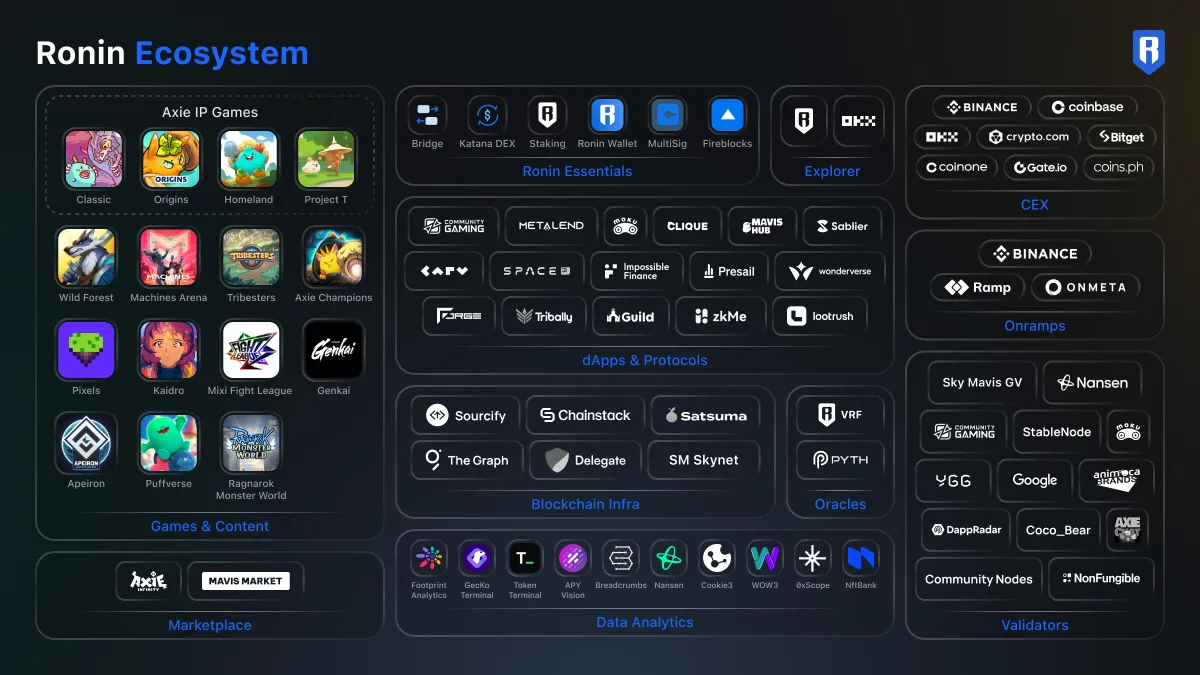
Image: Ronin
Part of a wider zkEVM push for games
Ronin wasn't alone. Polygon's zero-knowledge technology had already attracted Immutable, which partnered with Polygon on zkEVM infrastructure for games in 2023. The idea that each big game might want its own scalable chain was spreading across the industry. If zero-knowledge proofs are new to you, our earlier piece on ZKP technology covers the basic idea.
Ronin's zkEVM testnet went live shortly afterward as a layer 2 of its Saigon testnet, according to the project's own posts and contemporary coverage.
What happened next
The plan for many game chains under Ronin was overtaken by a bigger change. In February 2025, Ronin opened its network to permissionless deployment, dropping the approval process that had controlled which apps could launch.
Then, in August 2025, Ronin announced it would move back to Ethereum as a layer 2 itself. After its validator community weighed 4 proposals, it chose Optimism's OP Stack, Optimism said in September 2025, with RON kept as the gas token. On May 12, 2026, at block height 55,577,490, Ronin hard-forked from an independent sidechain into an Ethereum layer 2, BlockchainGamer reported.
The June 2024 announcement still matters as a snapshot of how gaming chains were thinking about scale. Its core question, how to keep many popular games running smoothly on shared infrastructure, didn't go away. Ronin simply chose a different answer.
Frequently asked questions
What is Ronin zkEVM?
Ronin zkEVM was a plan, announced June 18, 2024, to let game developers launch their own zero-knowledge layer-2 chains on top of Ronin using Polygon's Chain Development Kit.
What did a studio need to launch a Ronin zkEVM chain?
Ronin said deployment would be permissionless, but whoever launched a chain had to run a Ronin validator, which required 250,000 RON.
Is Ronin an Ethereum layer 2 now?
Yes. Ronin announced its move back to Ethereum in August 2025 and hard-forked into an OP Stack-based Ethereum layer 2 on May 12, 2026.
Who builds Ronin?
Ronin was created by Sky Mavis, the Vietnam-based studio behind Axie Infinity.
Sources
- Ronin: Introducing Ronin zkEVM (June 18, 2024)
- Cointelegraph: Ronin to launch zkEVM for Web3 gaming (June 18, 2024)
- BlockchainGamer.biz: Ronin scales with zkEVM chains powered by Polygon
- Polygon Chain Development Kit
- Optimism: Ronin is coming home to Ethereum with Optimism's OP Stack (September 2025)
- Ronin: Powering Ronin's homecoming to Ethereum with the OP Stack (September 2025)
- BlockchainGamer.biz: Ronin hardforks, becoming an Ethereum L2 (May 2026)
Featured image: Ronin
Your questions answered
What is Ronin zkEVM?
Ronin zkEVM was a plan, announced June 18, 2024, to let game developers launch their own zero-knowledge layer-2 chains on top of Ronin using Polygon's Chain Development Kit.
What did a studio need to launch a Ronin zkEVM chain?
Ronin said deployment would be permissionless, but whoever launched a chain had to run a Ronin validator, which required 250,000 RON.
Is Ronin an Ethereum layer 2 now?
Yes. Ronin announced its move back to Ethereum in August 2025 and hard-forked into an OP Stack-based Ethereum layer 2 on May 12, 2026.
Who builds Ronin?
Ronin was created by Sky Mavis, the Vietnam-based studio behind Axie Infinity.
Last updated NOV 18, 2026