
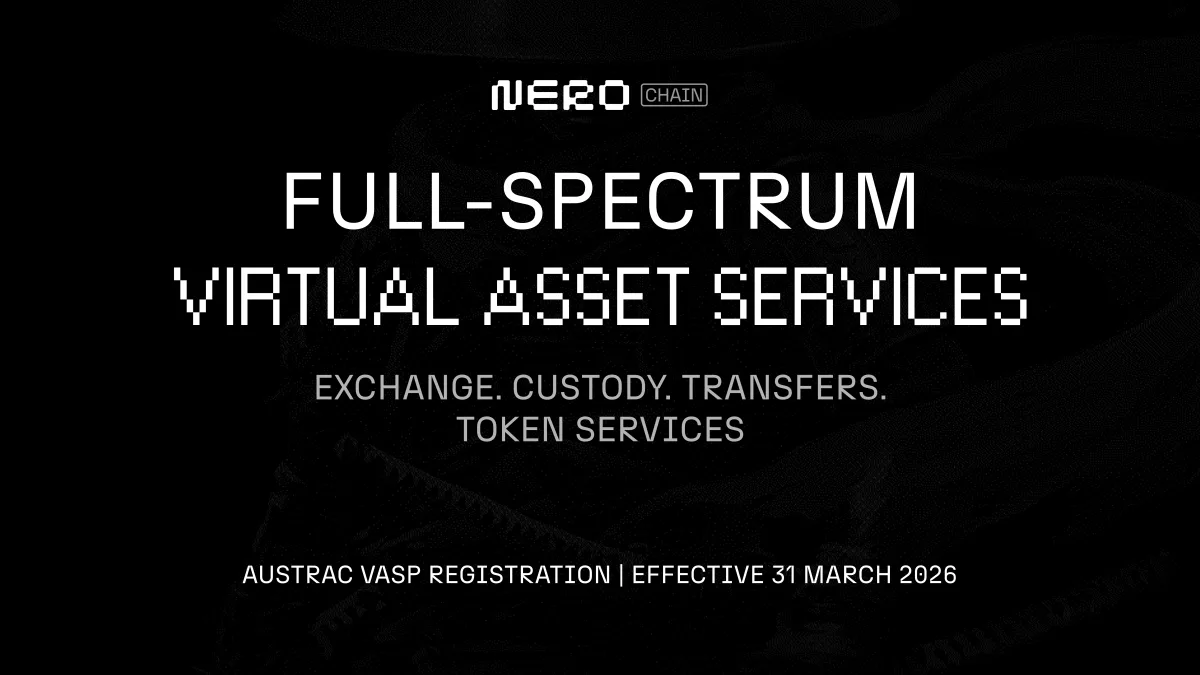
NERO Chain said on April 22, 2026 that its Australian company, NeroChain Pty Ltd, was registered with the Australian Transaction Reports and Analysis Centre (AUSTRAC) as a virtual asset service provider, or VASP. The company said the registration took effect on March 31, 2026, three weeks before it went public with the news.
Historical news event: April 22, 2026. Retrospective report prepared November 2026.
What NERO Chain announced
In its announcement, NERO said it had first held a Digital Currency Exchange (DCE) registration with AUSTRAC and had "since secured the more stringent VASP registration." It said the new status let the Australian entity offer four kinds of service:
- crypto-to-fiat and crypto-to-crypto exchange;
- virtual asset custody and safekeeping;
- virtual asset transfers;
- services connected to token offerings and sales.
The company said all clients would be subject to know-your-customer and anti-money-laundering checks under Australian rules, and published its registration number, which still carries the DCE prefix: DCE100888792-001. It also said it holds a gold bullion trading licence, and presented the two together as a regulated route into real-world assets, including the tokenisation and exchange of precious metals. The company wrote that "we believe compliance is not a constraint but a competitive advantage."

Image: NERO Chain
Why March 31 matters
The effective date wasn't random. March 31, 2026 was the day Australia's long-planned anti-money-laundering reforms took effect, as Decrypt reported in May. The reforms replaced the old "digital currency exchange" category with the broader VASP term and extended anti-money-laundering obligations beyond simple cash-to-crypto swaps to services such as custody and brokerage. Further Travel Rule requirements for virtual asset transfers were set to become mandatory on July 1, 2026.
In other words, NERO's upgrade from DCE to VASP lined up with a change to the whole Australian framework, which every crypto business in the country had to adapt to, not only NERO. That doesn't make the registration less real, but it puts the company's wording in context. It also means readers should treat "more stringent" as a description of Australia's new rules, which apply to the whole sector, rather than as a special status granted to NERO alone. NERO's release did publish its registration number, which gives customers and partners a reference to check against AUSTRAC's records.
What AUSTRAC registration is, and isn't
AUSTRAC is Australia's financial intelligence agency and its anti-money-laundering and counter-terrorism financing (AML/CTF) regulator. A registered business must identify its customers, monitor transactions, keep records and report suspicious activity. Registration means a business is inside that system and subject to its supervision.
It isn't a licence to sell financial products, and it isn't approval of a token, an investment or a company's software. In Australia, financial services and markets are licensed separately by the securities regulator, ASIC, which Cryptomorrow covered back in 2018 when it moved to regulate cryptocurrency markets. Depending on the product, a crypto business may need permissions from both agencies, and from regulators in other countries where it serves customers.
NERO's release described the registration as authorising it to offer its listed services. More precisely, the registration lets the Australian company provide those services while meeting AML/CTF rules. Whether a given product also needs an ASIC licence depends on how it is structured.
Compliance as a selling point
The announcement was aimed at builders, businesses and institutions looking for a regulated partner. Companies thinking about blockchain settlement often need to know who checks customer identities, who monitors transactions and which entity reports suspicious activity. A fast network doesn't answer those questions, and many crypto projects have learned that banks and large partners ask about compliance before technology. For background on how blockchain firms approach these checks, see Cryptomorrow's look at blockchain-based KYC and AML tools.
Holding a registration is also different from running products under it. NERO's release didn't name customers or give volumes for exchange, custody or token services in Australia, and Cryptomorrow didn't find independent reporting on how the registration was being used. NERO Chain launched its token in 2025, when it set a July 28 token launch with listings on Bitget, Gate and MEXC, and spent early 2026 announcing partnerships and products, including the NERO YOSO prediction platform in Japan a month before the AUSTRAC news.
For the wider industry, the announcement shows how compliance has become part of the pitch. It's best reported for what it is: a company's stated registration under Australia's AML/CTF regime, with the obligations that come with it, not a blanket government endorsement.
Frequently asked questions
What did NERO Chain announce about AUSTRAC?
On April 22, 2026, NERO Chain said its Australian company, NeroChain Pty Ltd, was registered with AUSTRAC as a virtual asset service provider, effective March 31, 2026. It said it had previously held a Digital Currency Exchange registration.
What is a VASP in Australia?
A virtual asset service provider is a business offering services such as crypto exchange, custody, transfers or token-offering services. Australia replaced its "digital currency exchange" category with the VASP term when its AML/CTF reforms took effect on March 31, 2026.
Is AUSTRAC registration a financial services licence?
No. AUSTRAC registration covers anti-money-laundering and counter-terrorism financing obligations. Financial services licences are issued separately by ASIC, and registration isn't an endorsement of any token or product.
What services does NERO Chain say it can offer in Australia?
NERO listed crypto-to-fiat and crypto-to-crypto exchange, custody and safekeeping, virtual asset transfers, and services connected to token offerings and sales, with all clients subject to KYC and AML/CTF checks.
Sources
- NERO Chain: NERO Chain Unlocks Full-Spectrum Virtual Asset Services with AUSTRAC VASP Registration (April 22, 2026)
- NERO Chain news page (release dates)
- Decrypt: AUSTRAC launches supervision campaigns as Australia's crypto regulatory reforms kick in (May 8, 2026)
- Wikipedia: AUSTRAC
Featured image: NERO Chain
Your questions answered
What did NERO Chain announce about AUSTRAC?
On April 22, 2026, NERO Chain said its Australian company, NeroChain Pty Ltd, was registered with AUSTRAC as a virtual asset service provider, effective March 31, 2026. It said it had previously held a Digital Currency Exchange registration.
What is a VASP in Australia?
A virtual asset service provider is a business offering services such as crypto exchange, custody, transfers or token-offering services. Australia replaced its "digital currency exchange" category with the VASP term when its AML/CTF reforms took effect on March 31, 2026.
Is AUSTRAC registration a financial services licence?
No. AUSTRAC registration covers anti-money-laundering and counter-terrorism financing obligations. Financial services licences are issued separately by ASIC, and registration isn't an endorsement of any token or product.
What services does NERO Chain say it can offer in Australia?
NERO listed crypto-to-fiat and crypto-to-crypto exchange, custody and safekeeping, virtual asset transfers, and services connected to token offerings and sales, with all clients subject to KYC and AML/CTF checks.
Last updated NOV 26, 2026